Shredder
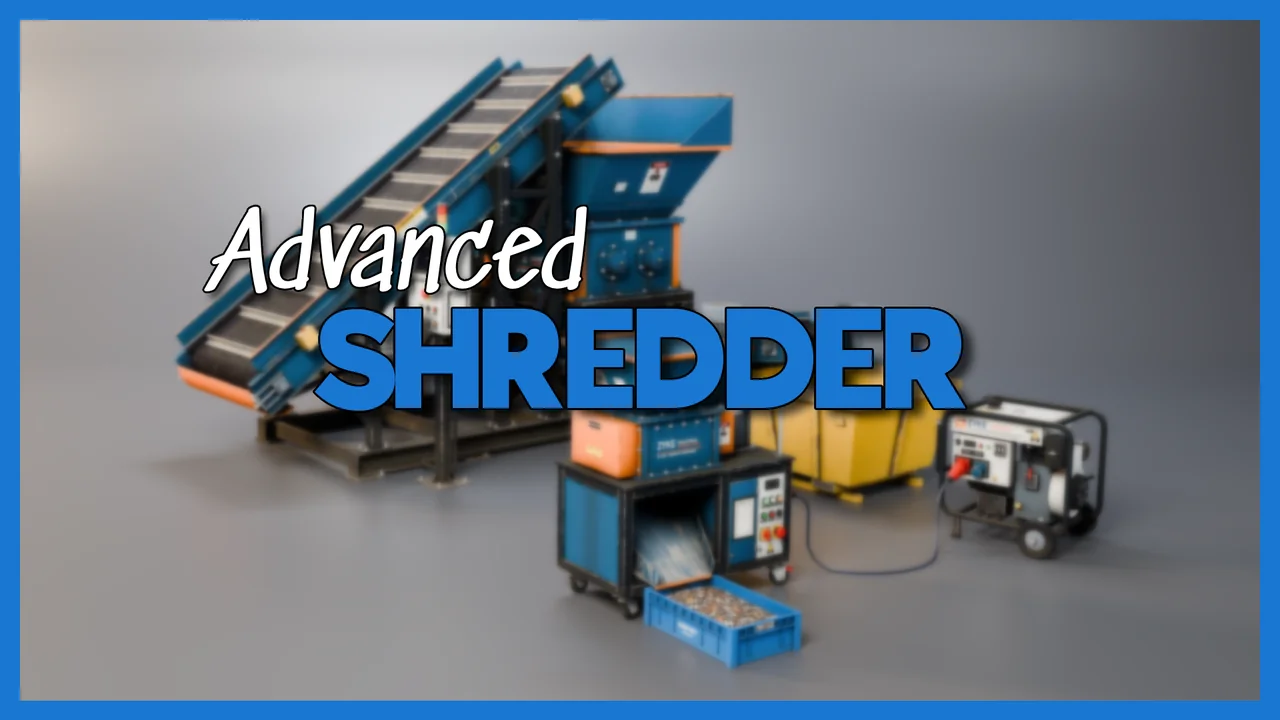
An industrial twin-shaft scrapyard shredder powered by a diesel generator, plus a compact shredder players carry as items and set up anywhere. Fuel the generator, load parts, then collect the scrap and sell it to the scrap buyer.
Infeed, twin cutters, conveyor, and bin.
Carried as items and set up anywhere.
Fuel them from diesel cans to keep running.
Outputs, amounts, and drop chances per item.
Shared demand and personal orders.
Same motion for everyone, kept across restarts.
Each configured machine has an inclined infeed, twin cutter shafts, an outfeed conveyor, a bin, a control pedestal, and a diesel generator.
Parts ride the belt as their own models, are cut with sparks or dust, and leave as scrap. The motion is synchronized for every player.
A screen above the line's control panel shows the machine state, cutter heat, diesel, bin fill, and the parts on the line.
Load any part with a recipe from the infeed's loading end, whether the machine is running or not. Parts still on the infeed can be taken back off unchanged.
Running a machine hard heats the cutters until the thermal cutout stops it. Parts occasionally jam the cutters, which reverse briefly to free them.
The generator burns diesel while the shredder runs, and an empty tank stops the machine. Partly used diesel cans keep their remaining litres, and fuel can be disabled entirely.
A small shredder, a portable generator, a power cable, and a catch crate, carried as items and set up on any level ground, indoors or out. It takes one part at a time through a hopper and runs slower than the line.
Plug the cable in at the generator and carry the other end to the shredder. The catch crate docks at the shredder's outlet, and the shredder only takes a part while the crate has room for its output.
A generator running indoors builds up exhaust: first haze, then coughing and a dimmed view, then damage, until the engine stalls. Outdoors nothing builds up, and fumes can be disabled.
Placed props pack back into their items once stopped, unplugged, cooled down, and empty, and the generator keeps its diesel. Each prop stays in the routing bucket it was set up in, so it works inside instanced apartments.
Loading, operating, collecting, refuelling, linking, and packing up a placed set can each be limited to its owner or opened to anyone, with editable can-check hooks for jobs, gangs, or keys.
Recipes are keyed by input item, and each output has its own amount range and drop chance. Variants add outputs based on item metadata, so a rusty converter can produce rusty scrap.
The clipboard at the machine opens a searchable recipe book listing every part the shredder takes and the scrap it gives.
Over 100 default recipes cover converters, wheel clamps, angle grinder tools, and a range of electronics, tools, and household items. Each recipe sets whether the part also fits the compact shredder.
Bins are shared across all players by default, or kept per character. A part only enters the cutters once the bin has room for its output, and the heap in the bin grows as it fills.
The scrap buyer pays from a shared demand that drops as items sell and recovers over time. Each character also receives a three-item order that pays full price.
Machines retain their fuel, heat, and loaded parts across restarts, and placed compact sets stay where they were set up.
Every spot on a machine is used through interaction points by default, or through ox_target or qb-target instead.
The admin panel manages recipes and machines and shows statistics and a searchable activity log.
Loading, shredding, collecting, and selling are verified on the server, with server events, Discord webhook logging, and editable can-check hooks.
zyke_sounds provides the machine, generator, and pouring sounds.
Your cart is empty